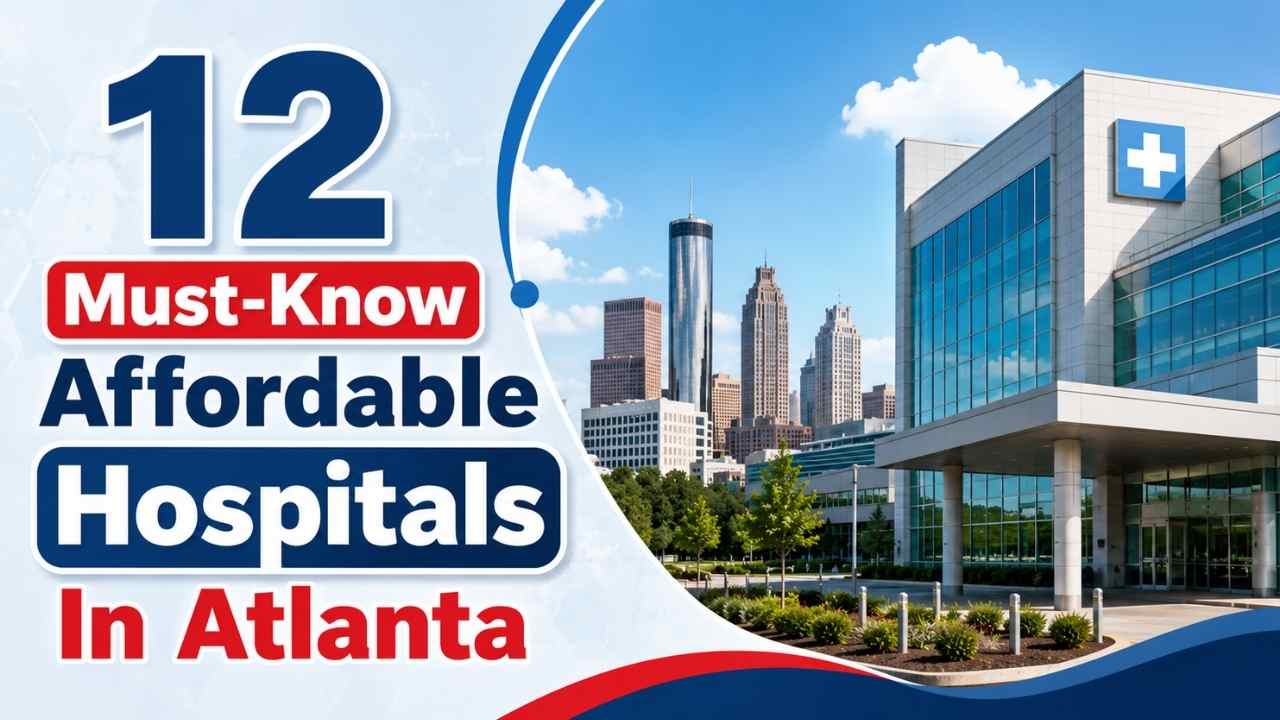
Finding affordable hospitals in Atlanta is achievable through major safety-net hospitals with generous charity care programs and Federally Qualified Health Centers (FQHCs) that offer sliding-scale fees based on income. If you’re uninsured, underinsured or living on a limited income, Metro Atlanta has more options than most people realize from large hospital systems with structured financial assistance to community clinics built specifically for low-cost care.
This guide covers the 12 must-know affordable hospitals, medical centers, and networks in Atlanta configured to care for uninsured, underinsured or low-income patients in 2026, along with what documentation you’ll need to apply and what Georgia law does and doesn’t protect you from.
Key Takeaway: Atlanta's affordable care options fall into three categories major hospitals with charity care programs, community health centers with sliding-scale fees and low-cost urgent care clinics for non-emergency issues.
Which Major Atlanta Hospitals Offer the Most Robust Financial Assistance?
The major hospital networks in Atlanta with the most robust financial assistance are Grady Memorial Hospital, Piedmont Atlanta Hospital, Northside Hospital Atlanta, and Emory Saint Joseph’s Hospital, each offering free or deeply discounted care based on federal poverty guidelines.
1. Grady Memorial Hospital
Grady Memorial Hospital is Atlanta’s premier public safety-net hospital. It features the Grady Card program, which grants low-income residents heavily discounted access to ongoing primary care, specialists and pharmacy prescriptions.
- Financial Terms: Offers 100% free care for households at or below 200% of the Federal Poverty Level (FPL), with structured sliding-scale discounts up to 400% FPL.
2. Piedmont Atlanta Hospital
Piedmont Atlanta Hospital is the flagship nonprofit facility of Piedmont Healthcare. It uses third-party presumptive screening to proactively apply charity care programs to eligible patients, meaning some patients may qualify without submitting a full application.
- Financial Terms: Provides full financial write-offs for patients with household income at or below 300% FPL.
3. Northside Hospital Atlanta
Northside Hospital Atlanta is renowned for women’s health, surgical care, and comprehensive outpatient behavioral health interventions.
- Financial Terms: Extends a complete 100% discount on eligible medical bills to individuals making up to 300% of the FPL.
4. Emory Saint Joseph’s Hospital
Emory Saint Joseph’s Hospital is Atlanta’s longest-serving faith-based hospital and explicitly includes indigent and charity care programs as part of its core mission.
- Financial Terms: Grants indigent care protection up to 125% FPL regardless of insurance status with charity care programs scaling up to 225% FPL for uninsured patients.
Key Takeaway: Grady Memorial, Piedmont Atlanta, Northside Hospital Atlanta and Emory Saint Joseph's each set different FPL thresholds for free or discounted care, so checking the specific hospital's policy against your household income is an important first step.
Which Community Health Centers in Atlanta Offer Sliding-Scale Care?
Community health centers in Atlanta offer sliding-scale care based on household income and size, making them a practical option for ongoing primary care, dental, and behavioral health needs without hospital-level pricing.
5. Good Samaritan Health Center
Located on Atlanta’s westside, Good Samaritan Health Center is a massive center delivering primary care, pediatrics, dental, mental health, and prenatal services under one roof.
- Financial Terms: Fees are calculated via a reduced sliding scale using household size and income. The center also dedicates a specific service day entirely to the homeless population for zero-cost care.
6. Southside Medical Center
Southside Medical Center is a comprehensive clinic hub operating across Metro Atlanta that supports uninsured and underinsured patients with primary care, OB/GYN and eye exams.
- Financial Terms: Offers free or low-cost care structures determined entirely by individual financial circumstances.
7. Mercy Care Atlanta
Mercy Care Atlanta is a sprawling network of Federally Qualified Health Centers providing primary medical, dental, vision and behavioral health infrastructure across the city.
- Financial Terms: Accepts all patients regardless of income. Programs leverage a sliding scale where basic medical fees start as low as $35 per visit.
8. The Urban Clinic of Atlanta
Operating in both Fulton and Clayton counties, The Urban Clinic of Atlanta treats chronic and acute illnesses and provides lab services and preventive screenings.
- Financial Terms: Tailored explicitly for patients who are 100% uninsured and living at or below 200% of the Federal Poverty Level.
Key Takeaway: Good Samaritan Health Center, Southside Medical Center, Mercy Care Atlanta and The Urban Clinic of Atlanta all use income-based sliding-scale models, giving low-income and uninsured patients access to ongoing primary, dental and behavioral health care.
Where Can You Find Low-Cost Urgent and Primary Care in Atlanta?
For non-emergency medical issues, avoiding the ER entirely is one of the fastest ways to save money, and Atlanta has several urgent and primary care providers with fixed, transparent self-pay rates.
9. The Family Health Center at West End
Located directly on York Avenue SW, The Family Health Center at West End serves as an accessible anchor for localized family medicine and wellness counseling.
- Financial Terms: Operates on standard FQHC sliding-scale models and accepts Medicaid and Medicare.
10. Grant Park Clinic
Grant Park Clinic is a “Medical Mission” clinic that has been active since 1984, specializing in adult primary care, pediatric treatments, and OB/GYN care.
- Financial Terms: Provides multi-tiered medical assistance programs designed to ensure care is affordable for low-income families.
11. Atlanta Urgent Care at Peachtree
Atlanta Urgent Care at Peachtree is an urgent care center operated by an emergency-room doctor, handling minor fractures, infections, stitches and immediate lab imaging.
- Financial Terms: Features highly structured self-pay packages for the uninsured, with specialized office visits starting at $150.
12. Buckhead Primary and Urgent Care Clinic
Buckhead Primary and Urgent Care Clinic is ideal for quick same-day walk-ins, prescription renewals and localized chronic condition checks.
- Financial Terms: Publishes explicit self-pay menus, including $150–$175 for medical office visits and flat $50–$100 charges for X-ray procedures.
Key Takeaway: The Family Health Center at West End, Grant Park Clinic, Atlanta Urgent Care at Peachtree and Buckhead Primary and Urgent Care Clinic give Atlanta residents transparent, lower-cost alternatives to a hospital emergency room for non-emergency care.
How Do Atlanta’s Financial Assistance Programs Compare?
Atlanta’s financial assistance programs compare most usefully when lined up by which type of care they cover and what income threshold qualifies for free or discounted treatment.
| Hospital / Clinic Network | Best Suited For | Key Financial Advantage | FPL Threshold for Free Care |
|---|---|---|---|
| Grady Memorial Hospital | Trauma, ER, and ongoing prescriptions | Grady Card for ongoing access to care | 100% free if ≤ 200% FPL |
| Piedmont Atlanta Hospital | Major surgeries and specialized care | Presumptive eligibility screening | 100% free bill write-off if ≤ 300% FPL |
| Northside Hospital Atlanta | Women’s health and behavioral health | Full discount on eligible bills | ≤ 300% FPL |
| Emory Saint Joseph’s Hospital | Faith-based inpatient and specialty care | Indigent care regardless of insurance | ≤ 125% FPL (indigent); ≤ 225% FPL (charity) |
| Good Samaritan Health Center | Complete dental, family, and primary care | Reduced, income-based sliding scale | Sliding scale, no fixed free-care cutoff |
| Mercy Care Atlanta | Community health, vision, and mental health checkups | Sliding-scale appointments starting at $35 | No income requirement to be seen |
Key Takeaway: Grady Memorial Hospital has the lowest free-care threshold among the major hospitals at 200% FPL, while Piedmont Atlanta and Northside Hospital extend free care further, up to 300% FPL.
Which Atlanta Hospital Offers the Most Generous Charity Care in 2026?
The most generous charity care in Atlanta, measured by the income level at which patients qualify for completely free care, generally comes from hospitals with the highest FPL thresholds, since a higher threshold means more people qualify.
What is FPL? The Federal Poverty Level is a government-set income threshold used by hospitals to determine who qualifies for free or discounted care. For example, 400% FPL for a family of four is approximately $132,000 per year. The higher a hospital’s FPL threshold the more people qualify for assistance.
| Hospital | Free Care Threshold | Discounted Care | Hardship Provision |
|---|---|---|---|
| Northside Hospital | ≤ 300% FPL (~$99,000/yr for a family of 4) | ≤ 300% FPL | Yes |
| Piedmont Healthcare | ≤ 300% FPL (~$99,000/yr for a family of 4), via presumptive eligibility screening | ≤ 300% FPL | No |
| Grady Health System | ≤ 200% FPL (~$66,000/yr for a family of 4) | Sliding scale up to 400% FPL | No |
| Emory Healthcare | ≤ 125% FPL (~$41,250/yr for a family of 4) | N/A | No |
| WellStar Health System | ≤ 125% FPL (~$41,250/yr for a family of 4) | ≤ 300% FPL, sliding scale | Yes |
Northside Hospital and Piedmont Healthcare currently offer the highest free-care thresholds among Atlanta’s major systems, at 300% FPL, while Grady Health System’s Medicaid-gap-focused model and lower threshold still make it the essential safety net for the region’s uninsured population, particularly through the Grady Card program for ongoing care.
Key Takeaway: Northside Hospital and Piedmont Healthcare currently extend free care to the highest income level (300% FPL) among Atlanta's major systems, while Grady remains the core safety-net provider for residents below 200% FPL.
What Documents Do You Need to Apply for Financial Assistance in Atlanta?
Applying for financial assistance at most Atlanta hospitals requires similar documentation, regardless of which system you’re applying to. Gathering these items ahead of time can speed up the process considerably.
- Proof of income for all household members (recent pay stubs, tax returns, Social Security or disability award letters, or a signed statement of no income)
- Proof of household size (tax return showing dependents, birth certificates, or a lease agreement)
- Government-issued ID (driver’s license, state ID, or passport) citizenship is not required
It’s worth noting that Grady Health requires Fulton or DeKalb County residency for its full financial assistance program, while WellStar may require asset disclosure in addition to income documentation. Always check the specific hospital’s requirements directly before applying, since policies can differ even within the same system.
Key Takeaway: Most Atlanta hospitals require proof of income, proof of household size, and a government-issued ID to apply for financial assistance, though residency and asset disclosure requirements can vary by hospital.
What Legal Protections Exist for Patients in Georgia?
Georgia has more limited state-level hospital billing protections compared to states like California or Illinois, which makes understanding hospital charity care programs especially important for uninsured residents.
- No Medicaid expansion: Georgia has not fully expanded Medicaid, leaving roughly 250,000 residents in a coverage gap. This makes hospital charity care programs even more important for uninsured Atlanta residents.
- Nonprofit requirements: Nonprofit hospitals must maintain charity care programs as a condition of their tax-exempt status, but Georgia does not set specific FPL thresholds by law, meaning thresholds vary from hospital to hospital.
- Grady as safety net: Grady Health System serves as the primary safety-net hospital for metro Atlanta, providing care regardless of ability to pay. The Grady Card program provides ongoing access to primary care, specialists, and pharmacy services.
- Statute of limitations: Georgia has a 6-year statute of limitations on written contracts, which can apply to certain medical debt collection timelines.
If you’re comparing how a very different healthcare funding model handles affordability, the Top 15 Best Affordable Hospitals In Glasgow guide covers Scotland’s NHS-based system, where care is free at the point of use rather than income-tested.
Key Takeaway: Georgia's lack of Medicaid expansion and limited state-level billing protections make hospital charity care programs and FQHCs an essential resource for uninsured residents, with Grady Health System serving as the region's core safety net.
Frequently Asked Questions About Affordable Hospitals In Atlanta
What is the Grady Card program?
The Grady Card program gives qualified low-income, uninsured residents ongoing access to primary care, specialists, and pharmacy prescriptions at Grady Health System, separate from a one-time charity care write-off for a single hospital visit.
Do I need to live in Fulton County to get financial aid at Grady?
Grady’s full financial assistance program, including Grady Cares and the Grady Card, is designed for Fulton and DeKalb County residents. Residents of other counties may still receive financial assistance for emergency services and related inpatient care, but should confirm current eligibility directly with Grady.
What documents do I need to apply for charity care in Atlanta?
Most hospitals require proof of income, proof of household size, and a government-issued ID. Some hospitals, like WellStar, may also request asset disclosure, so it’s best to check the specific hospital’s application requirements beforehand.
Can undocumented immigrants get free hospital care in Atlanta?
Citizenship is not required to apply for financial assistance at most Atlanta hospitals mentioned in this guide, based on their published documentation requirements. Specific eligibility can still vary by hospital, so it’s important to confirm directly with the facility.
What is FPL and how is it calculated?
FPL or the Federal Poverty Level, is a government-set income threshold updated annually by the U.S. Department of Health and Human Services, based on household size. Hospitals use a percentage of this threshold (such as 200% or 300% FPL) to determine who qualifies for free or discounted care.
Which Atlanta hospital gives the most generous charity care?
Based on free-care income thresholds, Northside Hospital and Piedmont Healthcare currently extend free care to patients at or below 300% FPL, the highest threshold among the major systems covered in this guide.
Does Northside Hospital offer free care to everyone under 300% FPL?
Northside Hospital extends a full discount on eligible medical bills to individuals with household income at or below 300% FPL, though eligibility can depend on specific circumstances, so applicants should confirm details directly with the hospital.
What is the difference between charity care and sliding scale?
Charity care typically refers to a full write-off of a bill for patients below a certain income threshold, while a sliding scale adjusts the cost of care gradually based on income and household size, often resulting in a reduced fee rather than a complete waiver.
Are urgent care centers cheaper than ERs in Atlanta?
For non-emergency conditions, urgent care centers like Atlanta Urgent Care at Peachtree and Buckhead Primary and Urgent Care Clinic generally offer lower, more predictable self-pay rates than a hospital emergency room, which is typically reserved for serious or life-threatening conditions.
What if I don’t qualify for any hospital charity program?
If you don’t qualify for a hospital’s charity care program, community health centers like Good Samaritan Health Center or Mercy Care Atlanta may still offer sliding-scale fees based on income, regardless of your specific eligibility for a hospital’s write-off program.
Disclaimer: This article is for general informational and educational purposes only. It does not constitute medical advice. Always consult a qualified healthcare provider for diagnosis, treatment, and medical decisions. Never disregard professional medical advice or delay in seeking it based on content from this article.



Be First to Comment